
How to Fix a Bike Kickstand That Stopped Holding
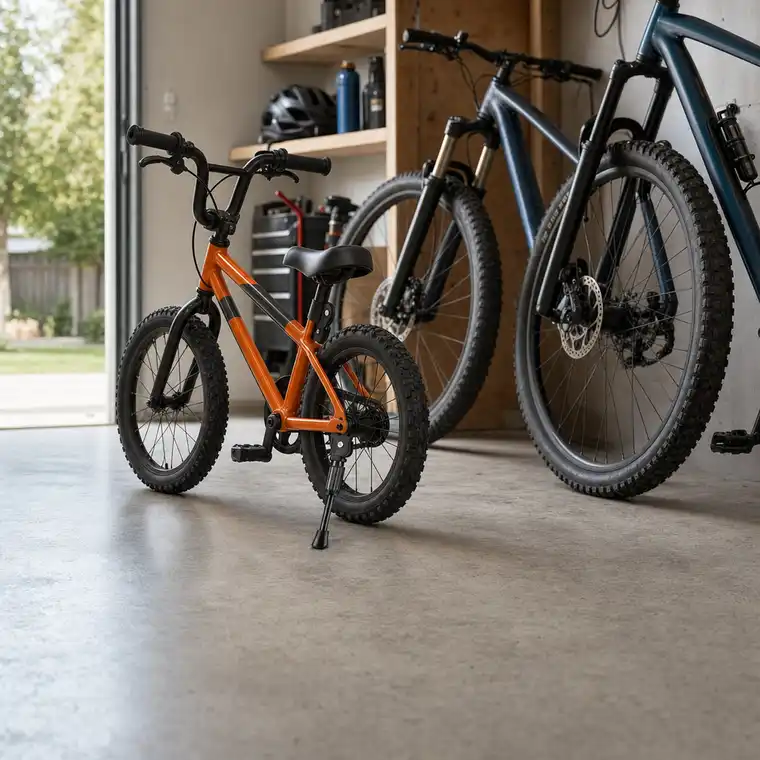
A kickstand that carried a bike for years and then stops carrying it has almost never broken in the way people picture. Nothing snaps, and there is rarely a piece to pick up. One of four things has moved: the bolt that holds the stand to the frame, the plate against the tube, the pivot the leg swings on, or the foot at the bottom.
This guide starts after the stand has been in service. If yours has just arrived, or you have just bolted it on and the bike leans wrong, that is a fitting question rather than a repair, and the installation guide covers it. What follows begins later, on the morning the bike is lying on its side and nobody touched it.
How to fix a bike kickstand: find the part that moved before you touch a tool
This test comes first because three of the four faults produce the same symptom, a bike on the ground. Reaching for a wrench and tightening whatever is nearest often fixes the wrong thing, and on a thin-walled frame tube it creates a second problem.
- Stand the bike on the deployed leg. On a hard, flat floor: grass and gravel hide the fault because the foot sinks and everything feels soft.
- Hold the saddle and press down slowly. You are adding a few pounds, not testing the part to destruction. Watch the stand, not the bike.
- Look at the top of the stand. If the plate rocks against the tube, or the assembly turns around the frame, the fault is the bolt or the plate.
- Then the hinge. If the leg swings back toward the folded position under load, the fault is the pivot or the geometry it sits at.
- Then the middle of the leg. On an adjustable stand, a leg that shortens as you press is the sliding joint and its clamp. A single-tube leg has nothing there.
- Last, the foot on the floor. A foot that skates outward instead of staying put is the rubber sleeve, not anything above it.
One note before the fixes. A stand that has folded under load once will do it again, at a moment you have not chosen. Park the bike against a wall until the repair is done, and if the leg has ever dropped while the bike was moving, take the stand off before the next ride.
Footprint of the steel mounting plate, which is the entire contact patch between the stand and the frame
— Kickaroo product specification, 2026
The leg that folds under the weight of the bike
Start with what the stop does, because the fix follows from it. The top of the leg swings against a raised face on the plate and rests there. Positioned correctly, the leg reaches down and slightly back, so the bike's weight presses it into that face and the joint gets more stable the more it carries. Turn that around, so the leg reaches down and slightly forward, and the same weight pushes it toward folded. The part is unchanged; the load has flipped.
That flip usually arrives by way of the plate rotating on the tube, the next section. Fix the rotation and the folding goes with it. Check the direction first: fold the leg, deploy it, and look at the angle from behind the bike.
The second cause is a stop packed with grit. Road grime and dried mud build up on the resting face, and a leg that used to seat solidly now stops short, sitting on compacted dirt rather than metal. It feels stable in the hand and gives way under load. A rag and a small brush on both faces of the joint puts it back.
On the adjustable adult stand there is a third possibility: the leg getting shorter rather than folding. That is the sliding joint slipping through its clamp, and the bike settles progressively rather than dropping. The joint is described in adjustable versus fixed kickstands, and its repair is below.
The stand that swings round the stay and parks crosswise
This is the fault people describe as the kickstand having gone crooked, and it gives the most warning while getting the least attention. The stand still holds the bike, at an angle nobody chose, and that angle keeps moving. If you have found yourself nudging the bike upright after parking it, this is why.
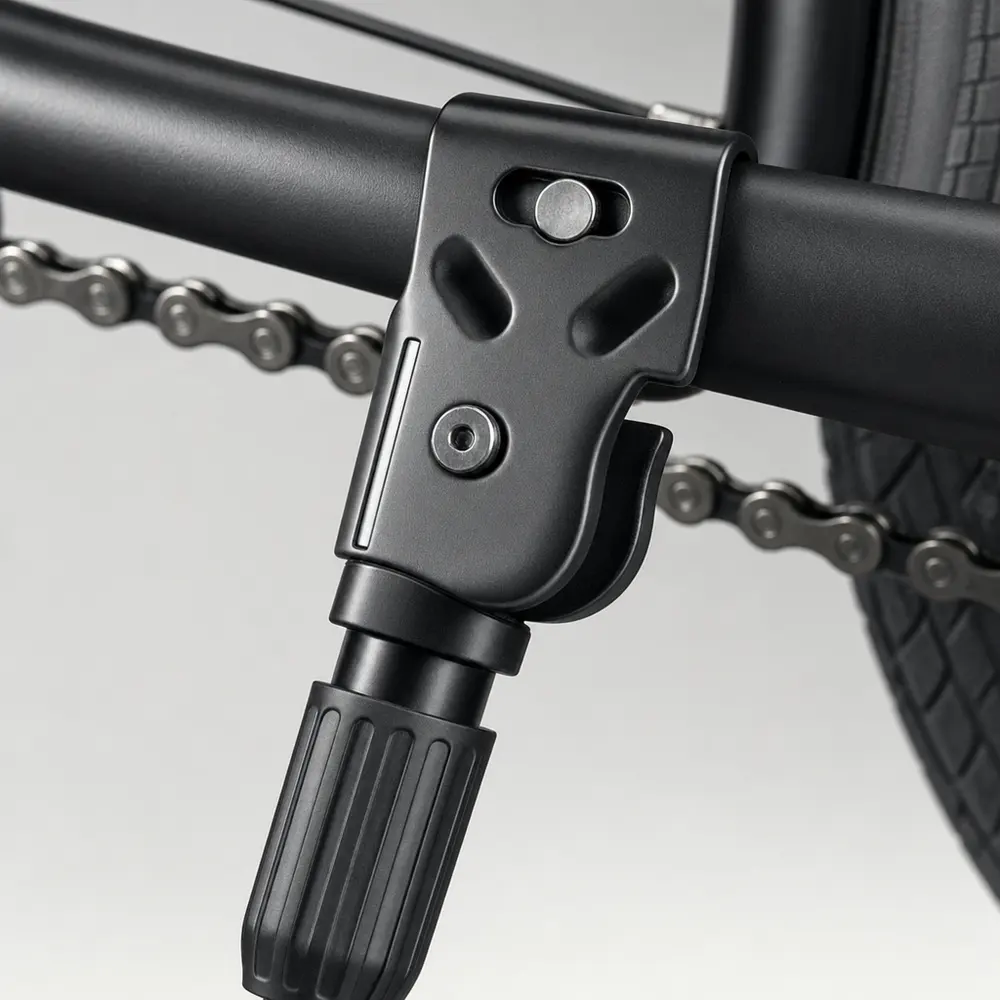
Two things stop a plate rotating. The first is shape: frames built for a stand carry a flat bracket behind the crank, and a plate seated on that flat cannot turn. The second is friction, all that holds a plate on a plain round tube, and friction is the one that fades. Dried mud compresses, the paint underneath flows a little, and the clamping force from day one is gone.
The repair is a reset rather than a part. Take the bolt out, take the plate off, and clean the tube, the underside of the plate and the thread. What you want is clean metal against clean metal. Seat the plate on the flattest section you can find, ideally the frame's own bracket, set the leg direction, and tighten back down.
The wrong repair here is more force on the bolt. A single bolt pulled harder than the tube can carry will dent a chainstay, and a dented stay is a frame repair rather than a stand repair. On a thin-walled aluminum stay, or near the bottom bracket junction, that limit arrives sooner than it feels like it should. On a carbon frame, do not clamp a stand to a tube at all: a clamp applies a concentrated point load across the directions carbon carries load along, and the damage can sit inside the tube with nothing showing outside, as the mountain bike kickstand guide sets out. We publish no torque figure for this part, so the test is the bike and not a number: tighten until a firm push with the heel of your hand no longer shifts the plate.
How to fix a bike kickstand that has developed play
Pivot play is what people notice first, because a leg that wobbles at the hinge feels alarming out of proportion to what it does. Some side movement is normal: the load runs straight down the leg, and the pivot only holds it in its plane. What matters is whether it can move far enough to change the lean angle. Deploy it, push the bike gently sideways, and watch the foot. If the foot stays put, the play is cosmetic.
What you can do about it depends on how the pivot is made. If it is a screw with a hex socket, it can be reseated: bring it down until the leg still swings under its own weight when you flick it, and no further. Overtightening is the opposite fault, with its own section in the installation guide. If the pivot is a closed rivet, there is no adjustment in it.
Joint play on an adjustable leg is repairable. The clamp collar grips the inner tube by friction, grit works in from wet pavement, and the collar loses its bite. Open the clamp, slide the tubes apart, wipe both dry and clean, and reassemble with no oil or grease near the clamping surfaces: a friction clamp with lubricant will never hold. Set the length, close the clamp, and load the leg by hand first.
On a fixed single-tube leg, which is what all five kids lengths are, there is no joint between the pivot and the foot, so nothing in the middle can develop play at all. That is the argument set out on the guide to picking a kickstand.
A rubber foot that is worn smooth, split or gone
Take the loose one first, because it is the quickest. A sleeve that has worked its way down the tube is a friction fit that let go, and a drop of contact adhesive inside makes it permanent. That fix is also in the installation guide.
A sleeve still in place but worn smooth is the state people miss, because at arm's length it looks new. The ribs moulded into the face are a wear item, and once parking on concrete has polished them flat the foot slides on a painted garage floor. The symptom is specific: the bike parks fine, then the foot creeps outward while nobody is watching until the bike goes down. Run a thumb across the face. If you cannot feel the ribs as ridges, they are not gripping.
The missing sleeve has the shortest answer. A bare tube end slides on smooth concrete, sinks into grass and hot asphalt, and scores a floor. A split sleeve does not come back with glue, and both ranges ship as complete stands with the foot already on the leg, so this is one of the cases where the part is replaced rather than repaired. Until then, keep the bike off it.
Ground belongs here too, because a foot in perfect condition can still be defeated by what is under it. Which surfaces hold a parked bike is covered in where to park a bike so it stays up.
How to fix a kickstand on a bike when the frame mount is at fault
The stripped thread is the most common and the least dramatic. A threaded mount on a chainstay bracket is a short thread in thin metal, and a part that takes an impact every time the bike is set down will round it out. The symptom is a bolt that turns without becoming tight. Where the bracket is open on both faces, pass a bolt straight through with a nut on the far side instead.
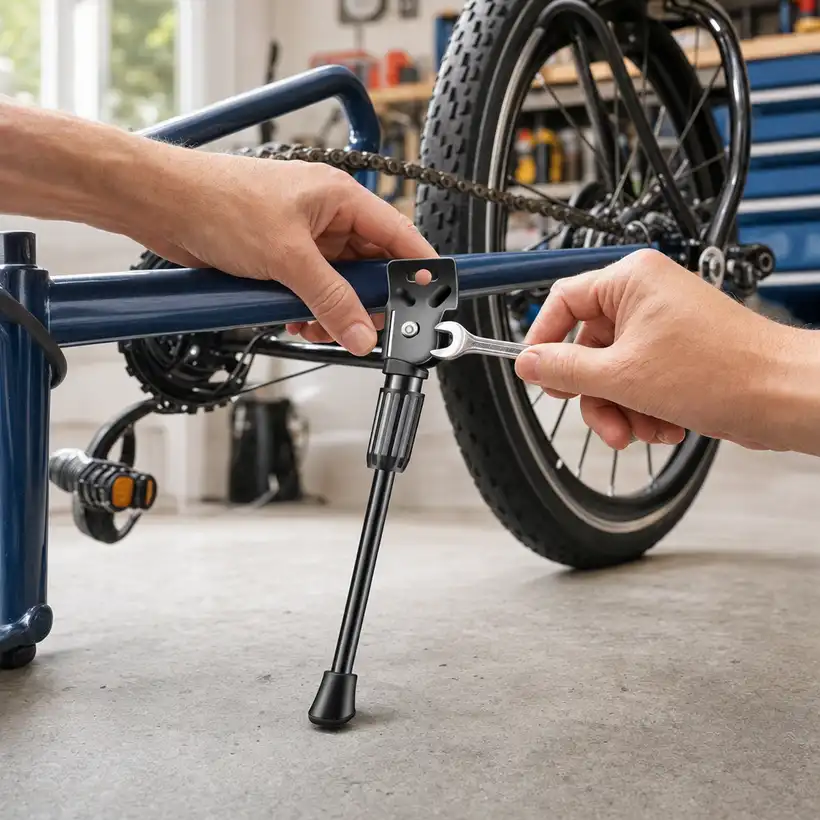
Bolt diameter the mounting hole accepts, equal to 8.0 to 10.0 mm, on a hole of 0.41 in or 10.5 mm
— Kickaroo product specification, 2026
What you should not do is chase a stripped thread with a larger bolt. The mounting hole in our plate is 0.41 in, or 10.5 mm, and it is made for a bolt of 0.31 to 0.39 in, or 8.0 to 10.0 mm. Going up a size leaves the plate with a bolt it can no longer locate, which moves the looseness rather than removing it. Both numbers are on the 16 inch kickstand page.
An elongated hole in the frame bracket is a harder verdict. Once the hole is oval the plate has somewhere to slide, and no amount of tightening gives back a fixed position, because a bolt can only hold what it can locate. That is frame work, in front of a mechanic.
The third case is a frame that never had a mounting point. A side-mount plate needs a flat surface and a hole, and where a frame offers neither, no repair changes that. Modern trail frames are often built with nothing back there, the subject of the mountain bike guide.
The stand that is marking the frame
The mark under the plate matters least. A clamped part sits on paint, and that paint carries the load until it wears through to the metal. On a steel frame keep an eye on it, because bare steel plus standing water is how a frame starts rusting from a spot nobody looks at. A smear of grease on the bare patch at reassembly takes care of it, kept off the bolt.
The polished line along the chainstay is the mechanical one. Folded, the leg should rest against its own stop on the plate, clear of the frame. Resting on the tube instead, it taps through every ride and wears a bright line into the paint. It also tells you the plate has moved, and that same rotation has been changing the lean angle. Reseat the plate and both symptoms leave together.
The groove in a tire sidewall comes from a plate mounted on the inner face of the stay, close to a wide tire. The clearance check that prevents it belongs to fitting, in the installation guide. What belongs here is the verdict once the groove exists: a worn sidewall is a tire you replace, and moving the plate forward toward the crank, where the stays are further apart, stops the next one.
What comes back, and what does not
| Part | What has happened to it | Does it come back |
|---|---|---|
| Bolt into the frame | Worked loose on rough ground | Comes back — a locking nut and one retighten |
| Plate on the chainstay | Rotated out of position on the tube | Comes back — clean the tube, reseat on the flat |
| Pivot | Stiff, dry or clamped up at fitting | Comes back — a fraction off the bolt, a drop of oil |
| Pivot | Play at a closed rivet | Does not come back — a rivet cannot be re-tensioned |
| Adjustable joint | Grit in the collar, leg sinking under load | Comes back — strip the joint, clean it, clamp dry |
| Rubber foot | Loose on the tube | Comes back — contact adhesive inside the sleeve |
| Rubber foot | Worn smooth, split or missing | Does not come back — the sleeve is not a serviceable part |
| Leg | Bent, then straightened cold | Does not come back — the metal keeps the bend |
| Mounting plate | Bolt hole gone oval | Does not come back — it can no longer hold an angle |
| Frame bracket | Thread stripped or hole elongated | Frame work, not stand work — take it to a shop |
The rows that come back are genuine repairs, and they hold for years.
The rows that do not come back behave differently, for the same reason in every one. A leg that was bent and straightened has a line where the metal yielded, and that line is the easiest place for it to yield again, which is exactly where you do not want a hinge. A hole gone oval has nothing left to locate the bolt, and a foot with no ribs has nothing left to grip.
One entry is neither, and it is the length. A stand that was correct on a 16 inch bike and has moved onto a 20 inch bike is not faulty: it is short for the frame it is on now, and there is nothing to repair. The kids lengths cannot be extended, so that one is settled with a tape measure on the sizing guide.
Putting the bike back on a stand you can trust
Most of what is in this guide is a reset you can do in the time it takes a kettle to boil, and a stand that gets a clean joint and a locking nut keeps parking a bike. Where a new part earns its place is the rows that do not come back, and it earns it on the foot in particular: a stand can be perfect above the ankle and still put a bike on the ground because the rubber has gone smooth.
The kids range is five fixed lengths, 7.3 to 11.0 in, for 12, 14, 16, 18 and 20 inch wheels, in painted steel with a moulded rubber foot and a 3 mm plate. The adult range is one adjustable stand in thickened aluminum alloy for 20 to 29 inch wheels, in a two-hole, three-hole or center-mount pattern. Both are picked the same way: read the number on the tire, then look at the bracket behind the crank.
Average across 416 verified buyer ratings on the kids range and 1,099 on the adult range
— Kickaroo verified buyer ratings, 2026
Where to go next depends on what the test at the top told you. If the stand needs refitting, the installation guide has the ten steps. If the bike has grown, the sizing guide settles it. For an adult bike or an e-bike, the e-bike kickstand page covers the wheel range and the mounting pattern. The rest is on the blog index, and an unusual mounting point can go through the contact page as a photo.
Put a fresh foot and a round hole back under the bike
Five lengths for 12 to 20 inch wheels and one adjustable stand for 20 to 29 inch, free shipping, and 30 days to send it back if the fit is wrong.
See the kickstand and pick your size