
Do Kids Bikes Need a Kickstand?
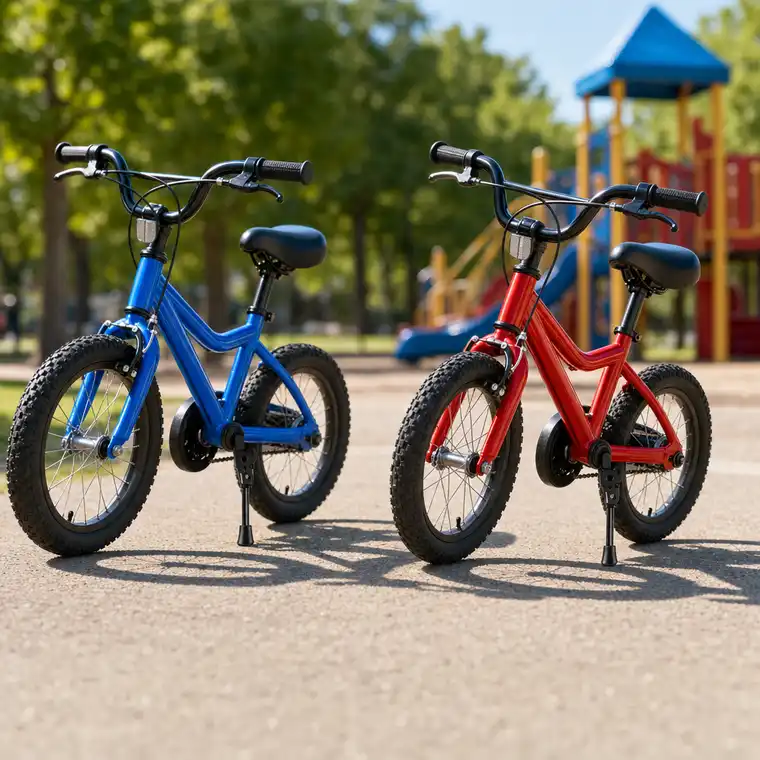
Walk past any elementary school at three in the afternoon and you will see the answer to this question written on the ground. There is usually a rack with a handful of bikes leaning into it, and then there is a scattered pile of bikes lying on their sides in the grass beside it, handlebars twisted, pedals in the dirt, one wheel still slowly turning. Nobody put them there out of carelessness. They went down because a child in a hurry had nowhere to stand a bike up and no reason to walk twenty feet to find one.
The question of whether a child's bike needs a kickstand has become oddly polarized, mostly because two different groups are answering two different questions. People who ride and race think about weight, obstacles and what happens on a trail. People who park bikes in a garage every evening think about scratched paint, bent brake levers and a bike that has to be picked up before the car can back out. Both are answering honestly. They are simply describing different bikes doing different jobs, and the useful version of the answer has to separate those situations rather than pick a side.
Why most kids bikes ship without one
Kids bikes are built to a price in a way adult bikes rarely are. A parent buying a first bike is usually comparing two similar-looking machines on a store shelf and choosing between them on price and color. Every part that gets added has to justify itself against that comparison, and a kickstand is the easiest part to remove because its absence is invisible in a photograph. The bike still looks complete.
There is also a genuine engineering reason that gets less attention. Adding a kickstand mount to a frame means designing a flat pad into the chainstay, which is extra tooling for the factory. It is cheaper to leave the tubes round. That is why so many children's bikes have no threaded mount at all and why an aftermarket stand has to clamp rather than bolt into a fitting.
The third reason is caution. A manufacturer that supplies a kickstand takes on responsibility for a moving part on a child's bike, and leaving it off transfers that decision to the parent. That is a statement about how product decisions get made when the buyer is an adult and the user is six, rather than a verdict on the part itself.
The weight argument, taken seriously
Weight of the longest kickstand length, sized for 20 inch wheels, at 159 g
— Kickaroo product specification, 2026
The reason the weight argument carries weight at all, so to speak, is that the ratio is unfavorable on small bikes. A 40-pound child on a 20-pound bike is carrying half their body mass around, which is nothing like an adult on a road bike. Every ounce that comes off a kids bike genuinely does make it easier to start, stop and pick up. Serious riders who strip parts off a child's race bike are not being fussy.
Where the argument gets stretched is in the leap from that principle to any specific part. A few ounces on a bike that already weighs several pounds is a change the rider will not perceive while pedaling. What they will perceive is the moment they have to lift the bike over a curb, and even there the difference is small. The framing is that weight is a real cost, that the cost is measured in ounces, and that whether it is worth paying depends entirely on what the bike is used for.
Complete shipped weight of one kickstand including its packaging, at 0.170 kg
— Kickaroo product specification, 2026
The cost argument, which is the real one
This is worth naming clearly because it changes how you should read the absence of a kickstand on a new bike. It is not evidence that the designers concluded a kickstand would be bad for your child. In most cases it is evidence that the bike had to hit a price and something had to go. The same bike sold in some European markets, where family bikes are more often used for transport, frequently arrives with a stand already fitted.
The counter-argument is that the money is better spent elsewhere. On a first bike, a set of decent brakes that small hands can actually squeeze matters more than anywhere a bike can be parked. If you have a fixed budget and the choice is between fixing the brakes and adding a kickstand, fix the brakes. That is not a difficult call.
The safety objection and what it is actually about
The version of this objection that holds up is specific: on very small frames with short chainstays, a folded stand can sit close to the arc the left crank arm travels through. If it is installed in the wrong place, a pedal can strike it. That is a genuine problem, and it is entirely preventable by turning the cranks backward twice during installation and watching the clearance. The installation guide makes that one of the three final checks for exactly this reason.
The version that does not hold up is the general claim that a parked bike falling over is more dangerous than a bike lying on the ground. Both are true hazards in different ways. A bike on its side in a driveway is something to trip over in the dark. A bike standing on a stand can be knocked onto a foot. Neither situation is an argument that settles the question by itself.
The practical conclusion is that this is an installation question rather than a design question. Two minutes spent checking crank clearance during the fitting resolves the version of the objection that has substance. How each length gets checked on real bikes is described on the how we test page.
When a kickstand earns its place
The clearest real example in our own buyer notes came from a parent fitting a stand to a balance bike so their child could leave it standing at the bike park instead of dropping it in the dirt every time they stopped. That is the use case in one sentence. The bike is not being ridden fast or far. It is being stopped, parked, picked up and ridden again forty times in an afternoon, and each of those forty stops is either a bike standing up or a bike on its side.
Daily transport is the other clear case. A bike ridden to school and parked in a crowded rack is safer standing on its own leg than leaning on a neighbor's frame, because the neighbor's bike will leave before yours does. A bike parked in a garage on a stand keeps its brake levers and its shifter off the concrete floor, which is where most damage on a child's bike actually happens.
Distinct machines described in buyer notes: a balance bike, a 14 inch kids bike, a first bike ridden without training wheels, and a heavy electric scooter
— Kickaroo buyer feedback, 2026
The ground a side stand needs under its foot
Every side kickstand carries the bike on a single contact patch about the size of a coin, ours included. That is what makes it light enough to leave on the bike and quick enough to flick down with one foot, and it is also what makes the surface matter. On concrete, asphalt, a garage floor or packed dirt the patch has something to push against and the bike stands where you put it. On a lawn after rain it sinks in, so parking on the paved edge of the grass, or setting the foot on a flat stone or a piece of board, gives it the base it is designed for.
Riding surface is the other thing the ground decides. Our stand is built for kids bikes with 12 to 20 inch wheels and folds flat along the chainstay when it is not in use, which is the shape that suits a bike parked at a school rack, in a garage or on a driveway. If you are looking at a genuine mountain bike, the mountain bike kickstand guide explains where a stand can attach and how to tell whether the frame has a mounting point at all.
The third case is the one parents ask about most, and it deserves its own section.
What happens the week the training wheels come off
This is the moment most people arrive at this question, and it is worth being clear about what a kickstand does and does not solve here. It solves the parking problem: there is once again somewhere for the bike to rest. It does not remove the need to teach the skill. A child still has to learn to slow down, put a foot down, step off, and either lay the bike down gently or set it on the stand. That lesson happens either way, and pretending otherwise would be selling something a piece of steel cannot deliver.
What actually changes is the number of times a day the bike hits the ground. One buyer described fitting a stand to a first bike for a three-year-old, noting that it attaches in place of the small wheels that had just come off. Another described their 12 inch bike as suiting "a child who doesn't use training wheels." In both cases the stand did not teach anything. It gave the bike somewhere to be between rides.
If you are at that stage, the practical question is which length fits, since the answer changes with wheel size. The sizing guide covers all five sizes from 12 to 20 inches and what to do when a bike falls between two of them.
The verdict, case by case
| Situation | Worth fitting? | Reason |
|---|---|---|
| Bike is parked at school, at a rack or on a sidewalk every day | Yes | A bike that stands up does not get walked over or knocked down the row |
| Bike lives in a yard, a driveway or a garage between rides | Yes | It stops the daily habit of dropping the bike on the lawn |
| Training wheels are still fitted | Not yet | The training wheels already hold the bike upright when it is stopped |
| Child rides on dirt, grass or loose gravel most of the time | Depends on the parking spot | The foot needs a firm base, so a paved edge or a flat stone is what it stands on |
| Bike is raced, jumped or ridden on trails | No | A stand adds a part that catches on obstacles for no benefit during the ride |
| Child is learning to balance and stop | Separate issue | Learning to lay a bike down safely still has to be taught either way |
Read across the rows rather than counting the yes answers. Most children's bikes in the United States spend far more time parked than moving, which is why the first two rows apply to more households than the last three. A bike that lives on trails and grass is the case where the surface it is parked on, rather than the stand, decides where it can be left standing.
Average across 416 verified buyer ratings for the Kickaroo kids bike kickstand
— Kickaroo verified buyer ratings, 2026
If you decide it is worth it
Start with the sizing guide, then read the adjustable versus fixed comparison if you are weighing designs. When the part arrives, the installation guide covers the ten minutes of work, including the bolt that is not in the box. Buyer photos are on the reviews page, the two most common sizes have dedicated pages at 16 inch and 20 inch, and every guide is listed on the blog index. Who we are is on the about page, and questions are welcome through the contact page.
If the bike needs somewhere to stand
Five lengths for 12 to 20 inch wheels at one price, free shipping, and 30 days to change your mind.
See the kickstand and pick your size